

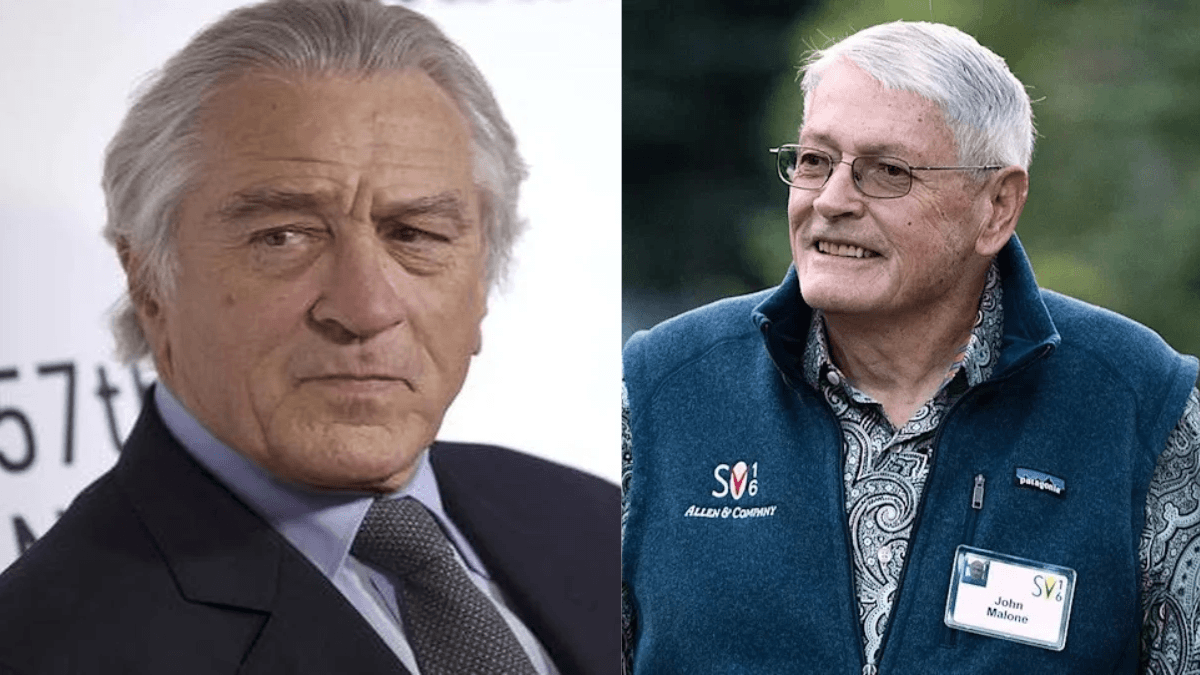
John Malone is a billionaire and media investor who made his fortune in cable and television, which is a very different world from the one Robert De Niro works in. When I started reviewing news coverage, company filings, biographical references and film databases for this article, I expected to find at least one small connection,
but I came away empty-handed. Plenty of people search for both names together, so the confusion is easy to understand, yet nothing documented shows that the two are linked. De Niro is an Oscar-winning actor, while Malone is a man of boardrooms and deal sheets, and their careers differ in almost every way. This article explains what can be confirmed and what simply cannot.
Robert De Niro and John Malone: No Business Partnership
The big question is whether they ever launched a business venture or had any commercial relationship, and the short answer is no. Their careers do intersect in the entertainment sector and the wider media economy, but that alone proves nothing about a business partnership. De Niro runs a set of business activities built around film production, directing, and cultural initiatives tied to Tribeca.
His professional decisions mostly center on developing creative projects, supporting filmmakers, and other entertainment-related activities. Malone, on the other hand, built his business career on corporate leadership, managing companies, evaluating investments, and setting the strategic direction of media organizations through cable television, telecommunications, and media investments.
In my own experience writing about media figures, mixing up a comparison with a confirmed collaboration is a common trap, and the distinction matters. When I checked the available biographical information, no direct link had been established, so any report of a personal meeting, an investment agreement, or that the two worked together needs additional reliable evidence. Until then, these claims stay unproven, even though both are influential figures in their fields.
| Detail | Robert De Niro | John Malone |
| Full name | Robert Anthony De Niro | John Carl Malone |
| Born | August 17, 1943, Manhattan, New York City | March 7, 1941 |
| Nationality | American (also holds Italian citizenship) | American |
| Known as | Oscar-winning actor, director, producer | “Cable Cowboy,” billionaire media investor |
| Education and training | HB Studio, Stella Adler Conservatory, Actors Studio | Yale University, Johns Hopkins University, doctorate in operations research |
| Main career | Film acting and production | Cable television, telecommunications, media investing |
| Key roles and work | Mean Streets, Taxi Driver, Raging Bull, The Godfather Part II | Chief executive of TCI (1973 to 1996), built the Liberty family of media companies |
| Major honors and milestones | Two Academy Awards, AFI Life Achievement Award (2003), Kennedy Center Honors (2009) | Liberty acquired Formula 1 (2017), published Born to Wired (September 2025) |
| Business ventures | TriBeCa Productions (1989), Tribeca Film Festival (2002), Nobu hospitality brand | Liberty Media, Liberty Global, Liberty Broadband, Qurate Retail, and board roles at Charter, Sirius XM, Live Nation, and others |
| Key relationships | Martin Scorsese, Jane Rosenthal | David Zaslav, Ted Turner |
| Connection to each other | No documented link | No documented link |
Two Different Roads to Influence
The careers of De Niro and Malone show distinct ways of becoming influential in entertainment. De Niro’s reputation grew through creative performances, collaborations with directors, and steady participation in film production. Malone’s influence developed through business strategy, corporate leadership, and big investment decisions. Their professional activities also demonstrate the relationship between content and distribution.
Films need actors, writers, producers, and production companies to bring stories to life, but they also depend on financing, marketing, and access to audiences. Television and other media businesses work inside the same interconnected environment, and I’ve always found that people forget how many hands touch a single project before it reaches a screen.
De Niro represents the creative side of this system. His performances in major films helped define how audiences see certain characters and stories, and his production work and cultural initiatives have supported filmmaking well beyond his own acting roles. Malone represents the corporate and infrastructure side.
Cable television and programming choices shape how shows reach households, how entertainment companies organize their assets, and how investment decisions affect the wider industry, and those things determine a lot more than most viewers realize. This comparison should not suggest that either man directly caused the other’s success. Their separate careers simply show the variety of professional roles that make up the modern entertainment landscape.
Who Is Robert De Niro?
Robert Anthony De Niro was born in Manhattan on 17 August 1943, the only child of painters Virginia Admiral and Robert De Niro Sr. He was raised mostly by his mother in Greenwich Village and Little Italy, and he left school at sixteen to study acting at the Stella Adler Conservatory. After some Off-Off-Broadway plays, he moved into film. His early screen work included films directed by Brian De Palma, such as Greetings,
The Wedding Party, and Hi, Mom! His breakthrough came through a collaboration with Martin Scorsese, which started with Mean Streets in 1973. Together they made ten feature films and one short, including Taxi Driver in 1976 and Raging Bull in 1980. I’ve always thought a partnership like that is rare, since it lasted across decades of work.
The awards followed. De Niro won two Academy Awards, for The Godfather Part II in 1974 and for Raging Bull. He also received the AFI Life Achievement Award in 2003 and the Kennedy Center Honors in 2009, and he was Emmy-nominated in 2019 for playing Robert Mueller on Saturday Night Live. His range runs from dramas like The Deer Hunter and Goodfellas to comedies like Midnight Run,
Analyze This, the Meet the Parents films, and The Intern. He directed and starred in two films, A Bronx Tale in 1993 and The Good Shepherd in 2006. Away from the camera, he is a producer and entrepreneur. With Jane Rosenthal, he founded TriBeCa Productions in 1989 and the Tribeca Film Festival in 2002. He holds United States and Italian citizenship, and a new entry in the Meet the Parents series, Focker-in-Law, is scheduled for release on 25 November 2026.
Who Is John Malone?
John Carl Malone was born on 7 March 1941, and he is an American billionaire, businessman, landowner, and philanthropist better known as the Cable Cowboy. Reference sources note that he earned degrees from Yale University and Johns Hopkins University, and people call him Dr. Malone because of his doctorate in operations research. His rise began at Tele-Communications Inc., or TCI, where he was chief executive from 1973 to 1996, according to Wikipedia. TCI later merged with AT&T,
and Malone went on to build a family of media companies under the Liberty name. Over the years his leadership and board roles have touched Liberty Media, Liberty Global, Liberty Broadband, Discovery, Qurate Retail, and Liberty Interactive, along with Charter Communications, Expedia, Sirius XM, Live Nation, DirecTV, and Lions Gate. His book, Born to Wired, was published in September 2025
and covers his work in cable, broadband, Formula One, and the Atlanta Braves. Malone is also known as an influential mentor. Reporting describes him as a long-time sounding board for Warner Bros. Discovery chief executive David Zaslav, who has reportedly called him Yoda. Earlier coverage also calls him an important backer of Ted Turner and CNN. When I first read about his career, what stood out was how rarely a dealmaker with that much money gets described as someone people actually go to for advice.
What De Niro Did Away From the Camera
De Niro’s professional activities go well beyond acting, and he has been involved in hospitality and cultural projects too. He became closely associated with the Tribeca community in New York, and together with producer Jane Rosenthal and others, he helped establish the Tribeca Film Festival after the September 11 attacks.
The first festival took place in 2002 and grew into an important cultural event in Lower Manhattan. He has also been tied to the Nobu hospitality brand, and those business interests have become a recognizable part of his public career next to film. I’ve always found it interesting when a famous face puts effort into a neighborhood instead of just a screen, and this is a good example of that.
How Liberty Media Grew Under Malone
Malone’s long career has been closely connected with the development of large media and communications businesses. His work with Liberty Media and related companies contributed to the growth of a corporate group with interests across several major areas. One of the best known examples is Formula 1,
since Liberty became closely associated with the sport after acquiring the championship in 2017. That acquisition expanded Liberty’s presence in international sports and entertainment, which says a lot about where the company was heading. Malone’s influence has therefore extended beyond traditional television
and communications into major entertainment and sports properties. When I follow how media groups change over time, this is the kind of move I find most telling, because it shows a company stepping outside the cable box and into live events people actually plan their weekends around.
Conclusion
Robert De Niro and John Malone are two prominent American figures whose professional achievements sit in different areas of the media world. De Niro established an enduring reputation through award-winning performances, filmmaking, and cultural initiatives, while Malone built his reputation on telecommunications leadership, cable television, and strategic media investments. Their careers intersect in the wider entertainment economy,
yet there is no established family relationship and no significant business partnership identified in the available information. Looking at their individual accomplishments gives a more reliable explanation of the keyword than any speculation about an undocumented connection. Their stories demonstrate that the media industry depends on both creative talent and business infrastructure.
Robert De Niro’s work shows how performances and storytelling can influence culture, and John Malone’s career shows how investment and corporate leadership shape the organizations that distribute entertainment. I’ve always felt this is the cleanest way to read the pairing, since each man kept to his own lane and still left a mark on what people watch.
FAQS
Are Robert De Niro and John Malone business partners?
No. Nothing in the available information shows a business partnership or investment deal between them.
Are Robert De Niro and John Malone related?
No family link has been identified between the two men.
Who is Robert De Niro?
He is an Oscar-winning American actor born in Manhattan on August 17, 1943. He is known for films like Taxi Driver, Raging Bull, and The Godfather Part II.
Who is John Malone?
He is an American billionaire and media investor, often called the “Cable Cowboy.” He led Tele-Communications Inc. (TCI) from 1973 to 1996 and built the Liberty family of media companies.
Why do people search for these two names together?
Both are well known in the wider media and entertainment world, so people often wonder if they are connected. A shared industry does not mean a shared business.
What does De Niro do besides acting?
He directs, produces, and helps run cultural and hospitality projects. He co-founded the Tribeca Film Festival in 2002 with Jane Rosenthal and is linked to the Nobu hospitality brand.
What is John Malone best known for?
He is best known for his leadership in cable television and telecommunications. His work with Liberty Media also reached sports, including Formula 1, which Liberty acquired in 2017.
How are their careers different?
De Niro works on the creative side, through performances and filmmaking. Malone works on the business side, through investments, corporate leadership, and media infrastructure.
Have they ever met or worked together?
There is no reliable evidence of a personal meeting or a joint project. Any such claim would need solid proof.
Where can I confirm these facts?
Check news coverage, company filings, biographical references, and the Academy’s official records for De Niro’s Oscar wins.
