

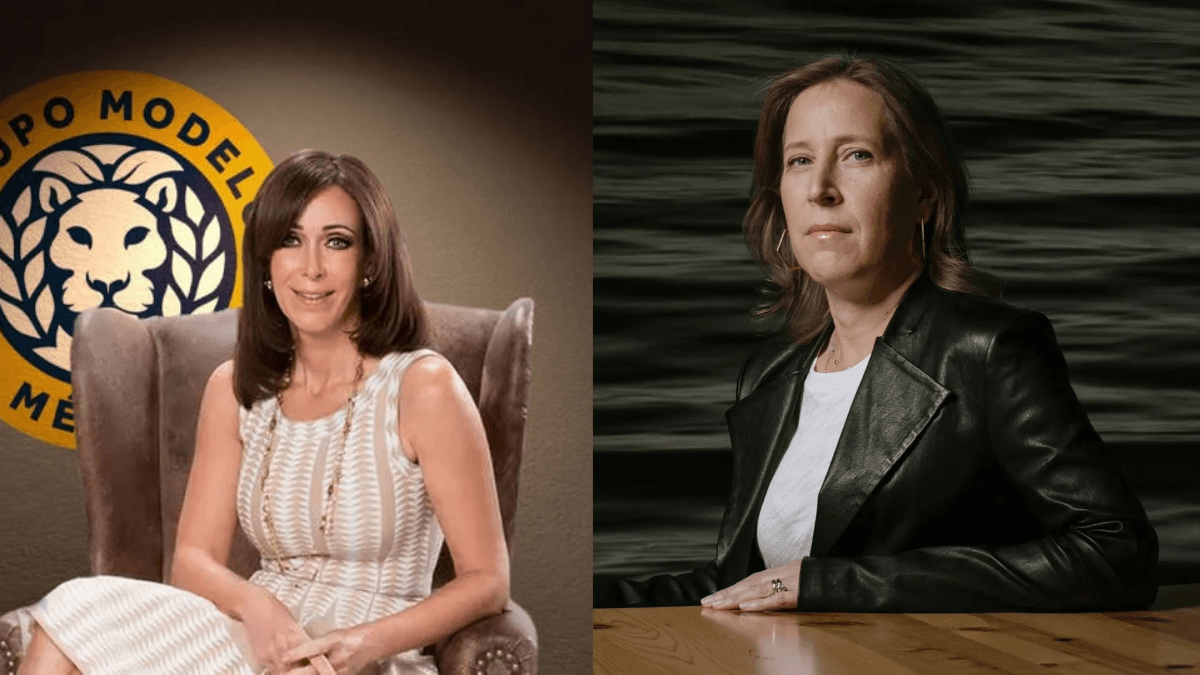
Susan Wojcicki was an American technology executive who became CEO of YouTube in 2014. She served in that role until she stepped down in 2023, and she died in August 2024 after living with lung cancer. María Asunción Aramburuzabala, on the other side, is a Mexican businesswoman and investor associated with Grupo Modelo and Tresalia Capital. Both became influential business leaders,
yet the public sources I could find do not show any direct personal or professional relationship between them. So why do people search for Susan Wojcicki and Maria Asuncion Aramburuzabala together? I think the question comes from how these prominent women read side by side: two names with significant success in different countries and different industries. Their professional journeys never crossed on paper, but what connects them is a business path that is still rare for women at that level.
Maria Asuncion Aramburuzabala and Susan Wojcicki: No Family Tie Found
I looked into this the way I would check any claim before repeating it, and there is no reliable public evidence that establishes a family tie. Maria Asuncion Aramburuzabala and Susan Wojcicki came from different family backgrounds, and each one built her careers in different countries. The story of Aramburuzabala is connected with Mexican business and investment,
while Wojcicki is tied to American technology and Silicon Valley. So why are they related in so many searches? Their names appear together mostly because both women became successful leaders, and a search connection like that does not prove a personal relationship. In my own experience, two big names showing up side by side online often says more about how people group success than about any real link between Susan Wojcicki and her Mexican counterpart.
| Detail | María Asunción Aramburuzabala | Susan Wojcicki |
| Nationality | Mexican | American |
| Known as | Businesswoman and investor | Technology executive |
| Born | Mexico City, May 2, 1963 | Not covered in the article |
| Education | Accounting at the Instituto Tecnológico Autónomo de México | Not covered in the article |
| Main companies | Grupo Modelo, Tresalia Capital | Google, YouTube |
| Career start | Took on a role in the family business after her father, Pablo Aramburuzabala, died in 1995 | Joined Google in 1999 as its first marketing manager |
| Key role | Investor with a family business background, expanding her investment activities | CEO of YouTube from 2014 to 2023 |
| Key event | Anheuser-Busch InBev completed its acquisition of the remaining shares of Grupo Modelo in 2013 | Supported Google’s acquisition of YouTube in 2006 |
| Industry | Brewing, investment, corporate governance | Technology, digital advertising, online video |
| Status | Active businesswoman and investor | Died in August 2024 after living with lung cancer |
Did These Two Leaders Ever Team Up?
When I try to answer this, I start by asking what a widely documented record would look like, and there is none. I found no evidence of a major professional partnership between them, and no collaboration that public biographies establish. Their careers developed independently. Aramburuzabala focused on investment,
entrepreneurship, corporate governance, and diversified business interests, while Wojcicki focused on technology, digital advertising, Google, and YouTube. In my view, the strongest comparison comes from studying their different approaches to leadership, not from hunting for a link that the record never shows.
Who Is Maria Asuncion Aramburuzabala?
The easiest way I know to explain her is to start with the family. María Asunción Aramburuzabala is a Mexican businesswoman who is mostly known for her investments and for her family’s historic connection to Grupo Modelo, the brewing company linked with Corona beer. She was born in Mexico City on May 2, 1963,
and she studied accounting at the Instituto Tecnológico Autónomo de México. Her professional life changed significantly after her father, Pablo Aramburuzabala, died in 1995. He left her an inherited interest in the family business, and that inheritance could have been something she simply held onto. Instead,
She was involved in maintaining it and protecting the business interests around it, and later she was expanding her investment activities. From what I have seen with family companies, that shift from receiving a share to actively guarding it is where most people either fade out or grow, and her path shows the second kind.
Who Was Susan Wojcicki?
If you want to understand her, it helps to look at the timing. Susan Wojcicki was an American technology executive who is best known for her leadership at Google and YouTube. She joined Google in 1999 as its first marketing manager, and she became an important figure in the development of its advertising business and consumer products. Her career grew during a period when internet companies were changing how people accessed information, watched videos,
and interacted with advertisers. Wojcicki was involved in the expanding digital business at Google and supported the acquisition of YouTube in 2006. Over time she turned into one of the most recognizable executives in online video. Having watched a few tech careers up close, I think the early marketing job matters more than people give it credit for, because it put her right where the product and the money met.
What Wealth Really Tells Us About Two Leaders
When people talk about prominent businesswomen, wealth is usually the first thing that comes up, and I have learned to be careful with any headline figure. Maria Asuncion Aramburuzabala and Susan Wojcicki show why financial success makes more sense when you look at the business interests behind it. The wealth of Aramburuzabala has been tied to family business holdings, investments, and ownership interests. Her link to Grupo Modelo is an important development in that history. In 2012, an earlier agreement was announced,
and in 2013, Anheuser-Busch InBev finished its acquisition of the remaining shares of Grupo Modelo that it did not already own. That transaction was big news for the international brewing industry, and it changed the ownership story of the company. Still, her broader investment activities mean her financial position cannot be read from one company or one deal. Private investments, ownership structures, changing asset valuations, and other financial interests make wealth estimates hard to verify.
Wojcicki followed a different road. Her financial success came mainly from her career at Google and her executive leadership at YouTube. Her compensation came from senior-level employment and equity-related compensation, and it rose with the growth of the technology business. Google became a commercial force through search advertising and related services, while YouTube grew into a central platform for online video.
These different backgrounds explain why any billionaire label should be treated carefully. Public estimates often rest on incomplete information, market prices, or assumptions about private assets. Without comprehensive financial disclosures, personal wealth figures should not be called confirmed facts. I find the better comparison is about influence: Aramburuzabala shows the power of ownership and investment strategy, while Wojcicki shows how leadership inside a successful technology company can bring professional rewards and financial rewards.
What Their Stories Reveal About Women in Business
The careers of Maria Asuncion Aramburuzabala and Susan Wojcicki give us different perspectives on the progress of women in senior business roles. Aramburuzabala became a prominent investor in a financial environment where women have often faced barriers to ownership and executive authority, while Wojcicki rose inside a major technology company in Silicon Valley, where leadership was also predominantly male.
Their experiences show that there is no single route to business influence. Some women are building careers by founding companies, some through executive management, and others through investment, corporate governance, or family businesses that they help develop and modernize. I have seen the same pattern in my own circle of friends, and it taught me to stop asking which path is best. Still, these achievements should not hide the structural challenges that remain. Access to investment capital, professional networks, board positions,
and senior leadership opportunities can look very different across industries and countries. Progress depends on more than individual talent, because institutions and professional environments decide whether that talent gets room to grow. Visibility matters too. When women hold influential positions, they can challenge assumptions about who belongs in boardrooms, investment committees, and technology leadership teams. Representation cannot fix every inequality,
but it can broaden expectations about leadership and professional success. For aspiring businesswomen, the lesson is practical: build commercial expertise, grow strong professional relationships, and learn how organizations create value. Good leadership often blends financial knowledge, operational experience, and strategic judgment with the ability to work with people from diverse backgrounds. Those are the same habits I would tell any friend to start on early, since the challenges do not disappear, but they get easier to handle with the right skills.
Conclusion
For readers researching both women, I always say the clearest answer is also the most accurate one. Maria Asuncion Aramburuzabala and Susan Wojcicki became influential businesswomen through different professional journeys. Aramburuzabala developed her career through family business ownership, investment, and corporate leadership,
while Wojcicki helped shape the advertising business at Google before leading YouTube. The public evidence I reviewed does not establish a direct personal relationship or a professional relationship between them. Their names can be compared meaningfully because of their business achievements,
but any stronger claim would need additional reliable documentation. Their individual careers are well documented, and a direct connection between them remains unverified. Having checked claims like this before, I have learned that a missing link is better left missing than filled in with a guess.
Frequently Asked Questions
Are Maria Asuncion Aramburuzabala and Susan Wojcicki related?
No. There is no reliable public evidence that they are related. They come from different family backgrounds and built their careers in different countries.
Did they ever work together?
No major professional partnership between them is widely documented. Their careers developed independently, one in Mexican business and investment, the other in American technology.
Who is Maria Asuncion Aramburuzabala?
She is a Mexican businesswoman and investor. She was born in Mexico City on May 2, 1963, and studied accounting at the Instituto Tecnológico Autónomo de México. She is known for her family’s long connection to Grupo Modelo, the brewing company linked with Corona beer.
Who was Susan Wojcicki?
She was an American technology executive. She joined Google in 1999 as its first marketing manager, helped build its advertising business, and later served as CEO of YouTube from 2014 to 2023. She died in August 2024 after living with lung cancer.
What happened to Grupo Modelo?
In 2013, Anheuser-Busch InBev completed its acquisition of the remaining shares of Grupo Modelo that it did not already own, after an earlier agreement announced in 2012.
What changed Aramburuzabala’s career?
Her father, Pablo Aramburuzabala, died in 1995 and left her an inherited interest in the family business. She went on to protect that interest and expand her investment activities.
What did Wojcicki do at Google and YouTube?
She helped shape Google’s advertising business and supported its acquisition of YouTube in 2006. She later became one of the best-known executives in online video.
Why do people search for these two women together?
Mostly because both became influential businesswomen with major success. A shared search does not prove a personal relationship.
Can we trust wealth estimates for either woman?
Treat them carefully. Public estimates often rely on incomplete information, market prices, and assumptions about private assets. Without full financial disclosures, exact figures should not be called confirmed facts.
What can we learn from comparing them?
There is no single route to business influence. One built her path through ownership and investment, the other through executive leadership in technology.
