

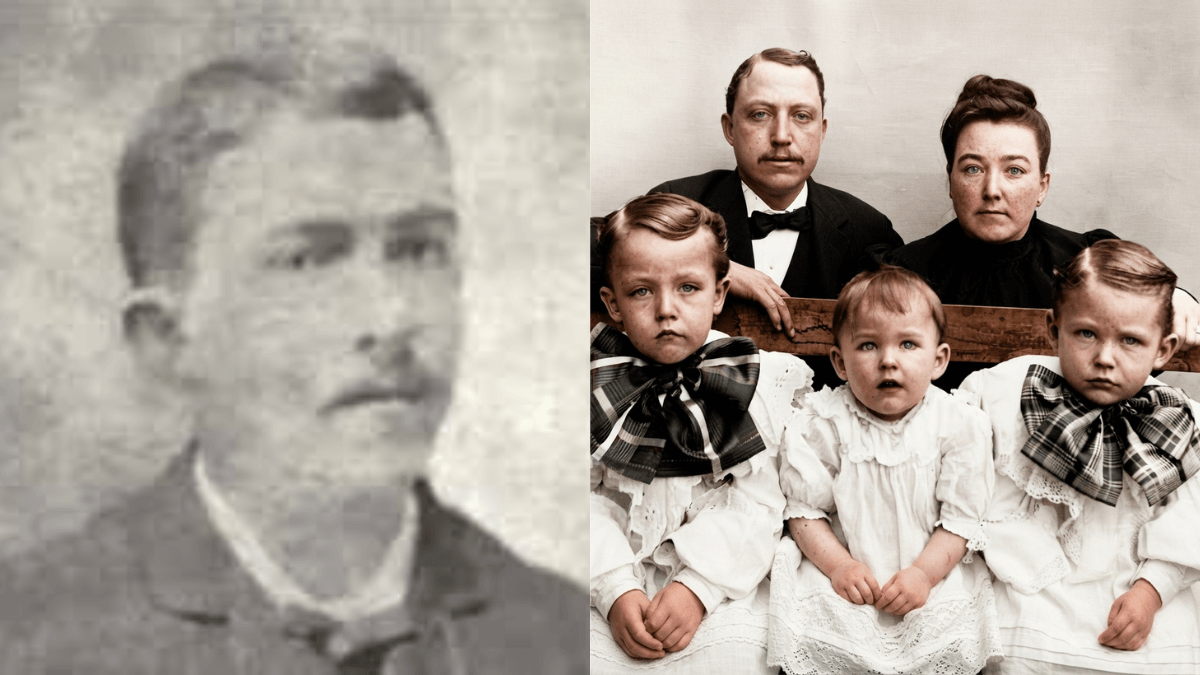
When I look at William Archibald Carter I find his story easier to understand through the South he lived in than through fame or public attention. Born on 12 November 1858 in Georgia and dying on 4 September 1903 he spent his life as a working man whose daily world was tied to the Georgia soil, land, labor and rural business. He was a farmer, mill owner and local businessman with property, ambition and an interest in ownership that reflected the economic life of his time. The changing South was still dealing with Reconstruction, a shifting landscape and the work of rebuilding after major disruption.
In that setting his story feels like that of a polished public figure and more like that of a local man building something through practical work. What makes Carter especially connected to American history and the wider American story is his place within a large family line. He became the grandfather of Jimmy Carter, giving his family a later connection to national life. Yet his impact on can also be regarded through the circle of relatives network he helped form across generations.
Families in the rural South regularly depended on inheritance, shared assets, work, and relationships that persisted from one technology to every other. I locate that this generational view gives a clearer photo of Carter: his own family line spread outward much like tree roots beneath a tough floor, linking private life, commercial enterprise, and social instances. His tale consequently belongs to a rural American setting and a broader record of circle of relatives, land, labor, enterprise, and generations.
William Archibald Carter’s Parents, Ancestry, and Family Line
When tracing William Archibald Carter, I find that the clearest starting point is his family network, especially the people behind his upbringing. He was the son of Littleberry Walker Carter, his father, and Mary Ann Diligence Seals, his mother. The death of his father in 1873 became a part of the family story leaving Mary Ann to care for the household and children. The older Carter foundation also included his grandparents, Wiley Carter and Ann Ainsley while the Seals line connected him to William Archibald Seals
and Eliza Harris on the Seals side. Looking through family trees and family histories these names help show how several families and family branches were connected through ancestry, lineage, land, labor, inheritance, customs and identity during the century. His siblings, including Jeremiah Calvin Carter, Annie Eliza Carter Ray and Nannie Bell Carter Jenkins add another layer to that story because brothers and sisters in households often shared work as co-workers,
shared property as co-heirs and faced hardship as co-survivors. In my experience, with family histories these relationships are rarely just ceremonial; they are usually practical shaped by relatives changing generations and the everyday needs of a household. Even the older names and branches become meaningful when viewed as part of the Carter and Seals family.
| Quick Bio | Details |
| Full Name | William Archibald Carter |
| Born | 12 November 1858 |
| Died | 4 September 1903 |
| Birthplace | Georgia, United States |
| Wife | Nina Pratt |
| Marriage | 8 September 1885 |
| Occupation | Farmer, mill owner, local businessman |
| Businesses | Sawmills, winery, cotton gin |
| Settlement | Rowena, Georgia |
| Father | Littleberry Walker Carter |
| Mother | Mary Ann Diligence Seals |
| Grandparents | Wiley Carter, Ann Ainsley, William Archibald Seals, Eliza Harris |
| Notable Children | Ethel Carter Slappey, William Alton Carter, Lula Carter Fleming, James Earl Carter Sr., Jeanette Carter |
| Famous Descendant | Jimmy Carter, grandson |
| Known For | Farming, local business, family legacy, and his connection to the Carter family of Georgia |
Marriage to Nina Pratt and the Household They Built
The marriage of William Archibald Carter and Nina Pratt took place on 8 September 1885 in Abbeville, South Carolina, beginning a partnership shaped by the needs of family life. Nina Pratt, born on 5 December 1863 in Due West, Abbeville County, was the daughter of James E. Pratt and Sophronia Caroline Cowan, while William became her husband and she his wife and spouse.
Their life centered on land, children, work, and survival, rather than any grand romance that would need to be added to the family history. From what I have seen in family records from this era, this kind of practical household was often built around shared duties and family continuity. After William’s death in 1903, Nina became a widow and matriarch who helped keep the family
and the family line together through the shock and uncertainty that followed. Her role became a bridge between the old century and the rising future of the Carter descendants, carrying the family descendants into later generations despite the violent uncertainty of the period. Her widowhood, care for the household, and connection to inheritance became part of the wider legacy, history, and continuing survival of the Carter family.
Children and the Next Generation
The large family of William and Nina became an important part of the Carter tale, with their children carrying the family line into the next generation. The known names in the Carter household are Ethel Carter Slappey, William Alton Carter, Lula Carter Fleming, James Earl Carter Sr. And Jeanette Carter. Ethel Carter Slappey was born in Arlington, Georgia on 5 February 1887 and after her marriage to Jack Linton Slappey in 1911 her daughter became part of another family line. As the visible branch Ethel helped carry the Carter name beyond the original household.
William Alton Carter, known as Uncle Buddy was born on August 17 1888 and after his work in Plains he started a business in 1909 creating one of the important lineage links between the older Carter world and the 20th-century Carter family saga. Another branch began with Lula Carter Fleming, born in Arlington on 19 May 1891 whose marriage connected the Carter household with the Fleming family and other adjacent families. James Earl Carter Sr., born on September 12 1894 became a farmer, merchant and Georgia House representative later entering life and becoming the father of President Jimmy Carter.
For me these family connections show how daughters, sons, relatives and descendants can become lineage and ancestry links, across generations. Jeanette Carter also appears in family documents and family records, although inconsistent dates and child lists make some details less certain. That uncertainty itself shows the size and complexity of the family story, while the children’s married lives, branch connections, business, work, and family history helped carry the Carter descendants from the 19th century into the 20th century.
Work, Property, and Local Achievement
When I look at William Archibald Carter’s working life, his story is strongly connected to land, farming, and industrial effort. He farmed as a farmer, whilst his business pursuits blanketed sawmills, a winery, and a cotton gin, all tied to the rural economy of his vicinity. His sawmill became raw cloth inclusive of wood into cost, the usage of a system and milling equipment to aid manufacturing and neighborhood motion. He additionally labored with farm acreage, equipment, and possession, displaying an understanding of profit, hard work, and the each day rhythm of agriculture.
To me, that transformation works as a beneficial metaphor for his existence: he took the resources around him and worked them into a larger agency through attempt, paintings, and entrepreneurial grit. His realistic toughness additionally sticks out in one family account, which says that when a twist of fate involving sugarcane, he treated a leg wound with a needle and thread himself. The element connects pain, damage, blood, and the hard activity predicted of men of his generation, who had been frequently expected to maintain transferring and treat survival as a part of ordinary paintings.
After he settled in Rowena in 1888, he became an established neighborhood parent within his community. His economic ambition became not countrywide within the countrywide sense, however his neighborhood fulfillment reflected enterprise, agriculture, rural business, neighborhood economy, operation, business enterprise, and financial increase. His acreage, device, enterprise hobby, and entrepreneurial grit gave him a visible location within the regional economic system and confirmed how a local man could construct belongings and impact via commercial and agricultural work.
Death, Aftermath, and Family Legacy
The death of William Archibald Carter on 4 September 1903 followed a violent confrontation in Rowena, creating a tragedy that changed the family and its household. After the loss of its patriarch, Nina and the children relocated toward Plains, and the aftermath brought questions of property, land, survival, and inheritance. From my experience reading old family history records, a death like this can reshape more than memories. It can change the geographic and emotional structure of everyday life.
The widow may take a role in decision making, children may depend on relatives and property may be sold as the family adjusts. In this case, the relocation, household restructuring, and family map reflected both practical needs and deep loss. The later family saga continued through the descendant line of James Earl Carter Sr. and Jimmy Carter, while Ethel, Buddy, Lula, and Jeanette remained part of the wider family line.
The Carter grandchildren and great grandchildren kept the Carter name alive across generations. Carter linked family history to public memory and public life. Carter sees this legacy as a lantern Carter passed down. The original light changes when it moves from one generation to another. Memory, lineage and continuity stay. Carter’s story goes beyond William’s life. Carter links his descendants, grandchildren and great-grandchildren to the continuing record of the Carter family.
Conclusion
When I look at William Archibald Carter, his importance becomes clearer at the meeting point of private family life and public history. He became a husband, father, landworker, mill proprietor, and local businessman, whilst additionally being the grandfather of a destiny president. His personal family life became linked to a much broader public tale, displaying how American records can develop from everyday places such as counties, farms, gins, stores, and family kitchens, rather than only from capitals and speeches.
His rural world turned into formed by using agriculture, farming, labor, belongings, trade, and neighborhood economy, at the same time as his enterprise, mill, ownership, and corporation pondered a practical ambition constructed thru work and callused fingers. His family and network shaped a part of the foundation that constructed the future and made the following technology. In that sense, his family history connects one generation to another and shows how an American county and its working families could become part of a much larger national story.
FAQS
Who was William Archibald Carter?
William Archibald Carter was a farmer from Georgia, a mill owner and a local businessman. William Archibald Carter was also the grandfather of former U.S. President Jimmy Carter. I find it fascinating that William Archibald Carter was involved in aspects of life.
When was William Archibald Carter born?
William Archibald Carter was born on 12 November 1858. I remember hearing about his birth date in family stories.
When did William Archibald Carter die?
William Archibald Carter died on 4 September 1903 after a confrontation in the Rowena area. It is a part of William Archibald Carter’s history.
Who was William Archibald Carter’s wife?
William Archibald Carter’s wife was Nina Pratt. William Archibald Carter and Nina Pratt were married on 8 September 1885 in Abbeville, South Carolina. I think the wedding was an event for William Archibald Carter’s life.
How many children did William Archibald Carter have?
William Archibald Carter and Nina Pratt had a family. William Archibald Carter’s notable children were Ethel Carter Slappey, William Alton Carter, Lula Carter Fleming, James Earl Carter Sr. And Jeanette Carter. The family legacy is quite remarkable for William Archibald Carter.
Who was William Archibald Carter’s father?
William Archibald Carter’s father was Littleberry Walker Carter. William Archibald Carter’s mother was Mary Ann Diligence Seals. The roots of William Archibald Carter run in the family tree.
What kind of work did William Archibald Carter do?
William Archibald Carter worked as a farmer. William Archibald Carter also ran rural businesses, such as sawmills, a winery and a cotton gin. It shows how industrious William Archibald Carter was.
Where did William Archibald Carter live?
William Archibald Carter was connected with Georgia. William Archibald Carter settled in Rowena in 1888. Became an established local figure. The community remembers William Archibald Carter fondly.
How was William Archibald Carter related to Jimmy Carter?
William Archibald Carter was the grandfather of Jimmy Carter. William Archibald Carter’s son, James Earl Carter Sr. was the father of Jimmy Carter. This connection highlights William Archibald Carter’s lasting impact.
