

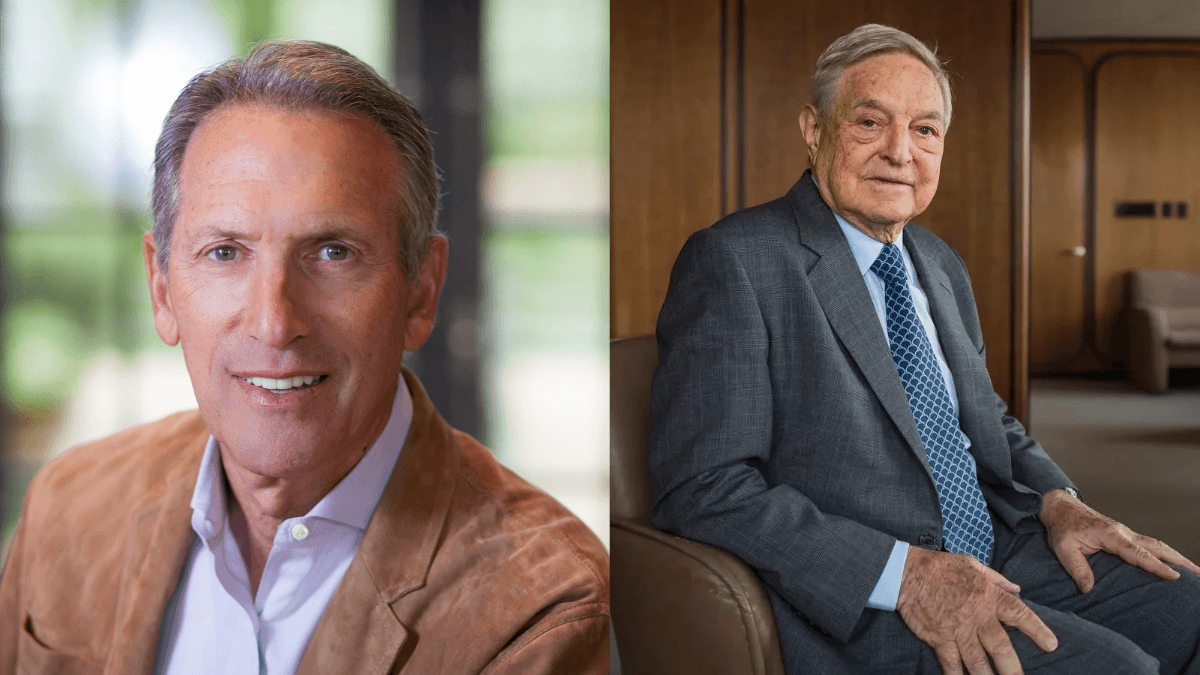
People often mention Howard Schultz and George Soros in the same breath when they talk about billionaires who shaped public life. One built a coffee company into a daily habit for millions. The other made his fortune in currency markets and then spent decades giving much of it away. Their stories rarely overlap, yet they share a few threads that make a side by side look worth your time.
Both men grew up without much money, and both made their names by trusting a hunch that other people dismissed. Both also stepped into politics in their own way, one as a possible independent candidate and the other as one of the biggest donors of modern times. This article walks through their early years, careers, money and legacies so you can see how each man earned his place.
Where Howard Schultz and George Soros Share Common Ground
Both men have argued that business and money carry a duty beyond profit. Schultz built health benefits and education programs into his company, while Soros turned a fortune into a network of grants. Neither claimed to be perfect, and both have said that wealth should serve something larger. That belief is probably the clearest link between the two stories.
Both have also faced a steady stream of criticism. Schultz’s critics point to the company’s long fight against unionization, which many workers and labor groups opposed. Soros’s critics point to his political spending and to a 2002 French insider trading conviction that he has always disputed. Fair readers can hold admiration and concern at once, and most people do.
| Detail | Howard Schultz | George Soros |
| Born | July 19, 1953 | August 12, 1930 |
| Birthplace | Brooklyn, New York | Budapest, Hungary |
| Known for | Building Starbucks into a global brand | Hedge fund investing and philanthropy |
| Education | Northern Michigan University | London School of Economics |
| Main organization | Starbucks (chairman emeritus) | Soros Fund Management, Open Society Foundations |
| Famous books | Pour Your Heart Into It, Onward | The Alchemy of Finance |
| Net worth | About $6.6 billion (Fortune, March 2026) | Several billion dollars after giving away more than $32 billion |
| Political label | Self described centrist independent | Major donor to liberal causes |
Howard Schultz and George Soros Compared
When you place Howard Schultz and George Soros next to each other, the first difference is the kind of power each one uses. Schultz built a consumer brand and shaped how workers and customers experienced it. Soros moved capital and then moved philanthropic money across borders. One worked mostly through a company, the other mostly through markets and foundations.
The second difference is political style. Schultz called himself a centrist and kept his political activity short, mostly a possible campaign and some public speeches. Soros became a major funder of liberal and progressive groups, and he has said so openly for decades. Their backgrounds point to a shared pattern too, because both men turned early hardship into a strong sense of purpose.
Who Is Howard Schultz?
Howard Schultz is the businessman most people link to Starbucks, even though he did not found the original Seattle shop. He joined the small company in 1982, left, and later came back to buy it. Over the following decades he turned a handful of stores into a chain with thousands of locations around the world. He also served as chief executive in three separate stretches.
His name carries weight beyond coffee because of how he talked about business. He often said a company should treat its workers as partners and not as a cost to be trimmed. He backed health coverage for part time employees and a college tuition program with Arizona State University. Admirers saw a rare executive with heart, while critics later argued the company’s actions did not always match his words.
Howard Schultz Early Life in Brooklyn
Schultz grew up in the Bay View public housing projects in Canarsie, Brooklyn. His father drove trucks and diapers for a living, and a broken ankle left him out of work with no insurance and no safety net. Schultz has said many times that watching his father struggle shaped everything he later did as an employer. That memory sits at the center of his story.
Sports offered him a way out. He earned a football scholarship to Northern Michigan University and graduated in 1975 with a communications degree. After college he sold copiers for Xerox, then moved into housewares sales for a Swedish company called Hammarplast. That job brought him to Seattle in 1981, because a small coffee retailer was ordering an unusual number of drip coffee makers.
Who Is George Soros?
George Soros is a Hungarian born American investor who built one of the most successful hedge funds in history. He is also the founder of the Open Society Foundations, a network that has given billions of dollars to groups working on human rights, education, public health and free expression. Few private individuals have funded so many causes in so many countries. That reach explains why people discuss him so intensely.
He is also one of the most polarizing figures in public life. Supporters see a survivor who spent his fortune defending democracy, and they point to his work in Eastern Europe after the Cold War. Critics accuse him of using money to push political outcomes in other countries. Both sides agree on one fact, which is that his giving has been enormous and hard to ignore.
George Soros Early Life and Survival in Budapest
Soros was born in Budapest in 1930 as Gyorgy Schwartz. His father, Tivadar, was a lawyer and a fan of Esperanto, the invented language meant to unite people. When Nazi forces occupied Hungary in 1944, the family hid and used false identity papers to survive. Soros was only a teenager, and he has described that year as the most formative of his life.
After the war he moved to London in 1947 and studied at the London School of Economics. He worked odd jobs to pay his way, including railway porter and waiter. At school he studied under the philosopher Karl Popper, whose ideas about open societies and the limits of certainty stayed with him for life. In 1956 he moved to New York and started a long career in finance.
Conclusion
Howard Schultz and George Soros took very different roads to wealth and influence. One built stores and habits, and the other built funds and foundations. Both started with little, both took big risks, and both left a mark that people still argue about. You can admire one, the other, both or neither, but their stories tell you a lot about how ambition and money can shape the world.
FAQS
Are Howard Schultz and George Soros related?
No, they have no family connection. They come from different countries, industries and generations. People compare them because both became rich, both spoke out in public life and both drew strong opinions.
What is Howard Schultz known for?
He is known for turning Starbucks into a global coffee brand. He served as chief executive in three separate periods and is now chairman emeritus. He also briefly explored an independent run for president in 2019.
What is George Soros known for?
He is known as a hedge fund investor and a philanthropist. His 1992 bet against the British pound became legendary. He also founded the Open Society Foundations, which have given billions of dollars to causes around the world.
How rich is Howard Schultz?
Fortune estimated his fortune at about 6.6 billion dollars in March 2026. Most of that wealth comes from his long stake in Starbucks. Figures like this move with the stock market, so they change often.
How much has George Soros given away?
His foundations say he has donated more than 32 billion dollars over his lifetime. Control of the Open Society Foundations passed to his son Alex Soros in 2023. The foundations continue to make large grants each year.
Did Howard Schultz ever run for president?
No. He explored the idea of an independent campaign in 2019 and ended it that September. He never failed to run.
Who runs the Open Society Foundations now?
Alex Soros chairs the board, after his father handed over leadership. George Soros remains the founder and the name behind the organization.
