

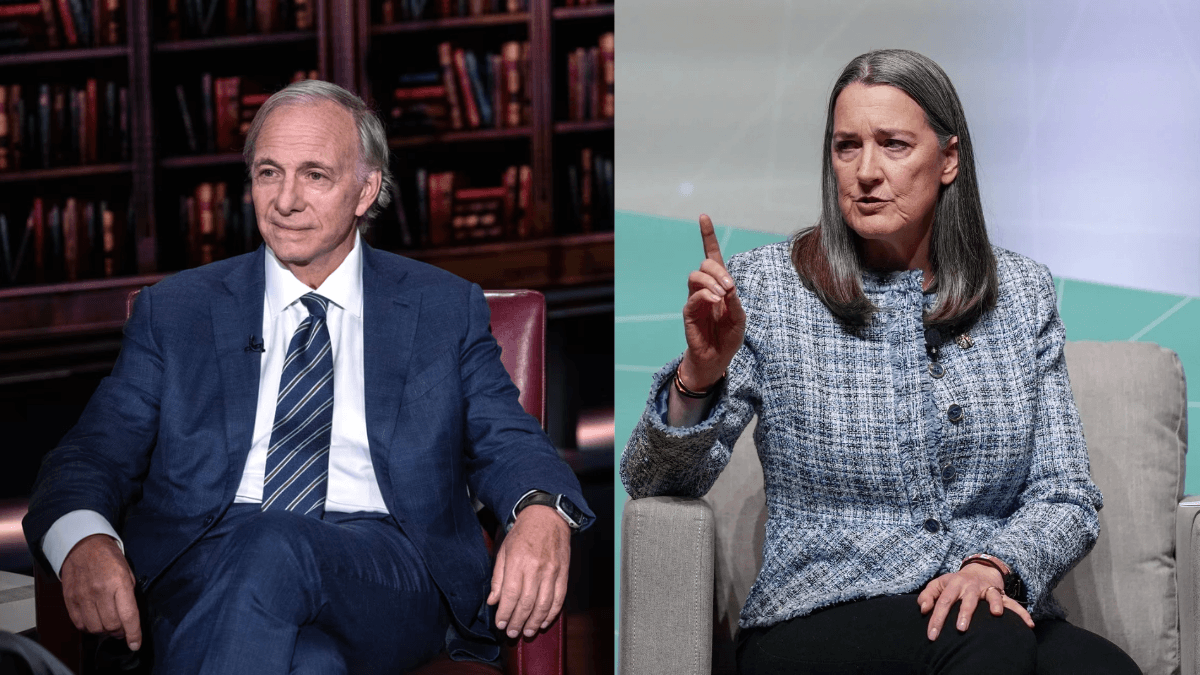
Typing Ray Dalio and Patricia Poppe Soros into a search bar looks like a simple request, but it blends three separate people into one phrase. Ray Dalio is the founder of Bridgewater Associates. Patti Poppe, whose full name is Patricia Kessler Poppe, runs PG&E Corporation. George Soros is the hedge fund veteran behind Soros Fund Management. This article sorts out who each person is and how the names ended up together.
Here is the short version. We found no record of a partnership, a shared company, or a family tie between these names. Poppe does not carry the surname Soros, and no source we checked links her to either investor. What connects them is the world of money, power, and public influence. The sections below explain each person and why readers tend to pair them.
Ray Dalio and Patricia Poppe Soros: Is There a Real Connection?
The most likely reason for the pairing is how names get blended online. Dalio and Soros are compared constantly in finance writing. An Economist profile of Dalio noted that he was following in Soros’s footsteps in several ways, including sharing his economic ideas in public. Poppe appears in business and energy news. A reader who saw all three names in one feed may have merged them.
Another reason is a habit people have when searching for famous figures. They half remember a name and attach a well known surname to it. Soros is one of the most recognized surnames in global finance, so it sticks easily. That does not make the pairing accurate. If you saw Patricia Poppe Soros written as a full name somewhere, treat it as a mistake until a reliable source says otherwise.
It pays to be careful here because false pairings spread quickly. A made up link between a utility chief and a famous investor can get repeated until it looks like fact. The rule for this piece was simple. We only state what appears in news reports, company announcements, or well documented biographies. Anything else is flagged as unconfirmed.
| Detail | Ray Dalio | Patti (Patricia) Poppe | George Soros |
| Known for | Founding Bridgewater Associates | Leading PG&E Corporation | Quantum Fund and Soros Fund Management |
| Born | August 8, 1949, New York City | 1969 | 1930, Budapest |
| Current role | Founder and CIO mentor at Bridgewater | CEO of PG&E Corporation | Founder of Soros Fund Management and Open Society Foundations |
| Education | Long Island University Post, Harvard MBA | Purdue University, Stanford master’s in management | London School of Economics |
| Notable fact | Wrote Principles and The Changing World Order | First woman to lead one Fortune 500 company and then another | Famous for his bet against the British pound |
Where Soros Fits Into the Story
George Soros was born in Budapest in 1930 and studied at the London School of Economics. He launched the Quantum Fund in 1973, and it became one of the most profitable funds ever run. His best known trade came in 1992, when he bet against the British pound. Accounts of that trade say it earned roughly a billion dollars, and it made his name worldwide.
Soros also built a reputation as a thinker. He credits the philosopher Karl Popper with shaping his ideas, and he developed a theory called reflexivity. The idea is that market prices do not just reflect reality but also change it, since beliefs feed back into events. A July 2026 report from the German outlet onvista said that theory looks especially relevant to talk of an AI bubble.
Soros Fund Management is still active, and the same report noted a larger position in Taiwan Semiconductor. Soros is also known for the Open Society Foundations, which fund causes around the world and draw strong opinions from both supporters and critics. None of this links him to Patti Poppe. His role in this article is to explain why Dalio’s name keeps landing beside his.
Ray Dalio: From Wall Street Floor to Bridgewater
Dalio was born on August 8, 1949, in New York City. He studied at Long Island University Post and then earned an MBA at Harvard. He founded Bridgewater Associates in 1975, and public profiles list him as co-chief investment officer since 1985. Today his title is founder and CIO mentor. Bridgewater is widely described as the largest hedge fund in the world.
Bridgewater grew by turning market ideas into rules that a team could test and repeat. Dalio is credited with popularizing risk parity and the All Weather approach, which try to spread bets across different economic conditions. Clients have included pension funds, endowments, and governments. Reports in recent years have put the firm’s assets at around 150 billion dollars.
Dalio also became well known through his writing. Principles described the habits he says shaped his firm, including open debate and honest feedback. Principles for Navigating Big Debt Crises focused on how debt cycles unfold. The Changing World Order, from 2021, looked at the rise and fall of major powers over several centuries. Time magazine named him one of the 100 most influential people in the world.
His name also shows up next to Soros for a number of reasons. In 2015, a ranking from LCH Investments said Dalio had overtaken Soros as the manager whose fund had made the most money for investors in history. At that point the Quantum Endowment Fund, which dates to 1973, had earned about 42.8 billion dollars. That ranking is one reason journalists keep placing the two men in the same sentence.
How Ray Dalio Thinks About Money and Power
Dalio’s style rests on the idea that markets and nations move in cycles. He has argued that debt builds up, strains the system, and then forces painful corrections. He studies history to spot where a country sits in that pattern. Supporters like how this gives investors a map. Critics say big historical patterns can be bent to fit almost any outcome.
Diversification is another theme he returns to often. His advice to ordinary investors is to avoid betting everything on one forecast, since even experts get the timing wrong. He has said that predicting the market on your own is a hard way to win. That message is less exciting than a big trade, but it matches the logic behind his All Weather work.
Dalio has also spoken about wealth gaps. In early 2022, Fortune reported that he urged countries including the United States to narrow inequality, and he praised parts of China’s common prosperity drive. That view drew both agreement and pushback, and reasonable people disagree on it. Anyone using his comments should read them in full, since short quotes can flatten what he meant.
Patricia Poppe: The Utility Chief Behind PG&E
Patricia Poppe, known as Patti, was born in 1969. She studied at Purdue University and later earned a master’s degree in management from Stanford’s Graduate School of Business in 2005. She began her career at General Motors in 1990 and spent about 15 years there. Her roles included power plant director and director of energy optimization, which gave her a hands-on view of how big operations run.
She moved into the utility world around 2011 and became president and CEO of CMS Energy in 2016, serving until December 2020. In November 2020, PG&E announced she would become its chief executive starting January 4, 2021. The company was only months out of bankruptcy at the time. Investors liked the choice, and the stock rose nearly nine percent on the day of the announcement.
PG&E needed a reset because equipment tied to the company was linked to deadly wildfires in 2017 and 2018, with more than 120 deaths reported. The company’s chairman called Poppe the perfect fit. A consumer advocacy group, The Utility Reform Network, said it was skeptical, given the record of earlier CEOs. That mix of high hopes and doubt has followed the job ever since.
Poppe is described as the first woman executive to serve as CEO of one Fortune 500 company and then become CEO of another. Crain’s Detroit Business named her one of its 100 Most Influential Women in 2016, and she has been inducted into the Automotive Hall of Fame. In a July 2026 company report, she summed up PG&E’s progress by saying that love works. It is an unusual line for a utility boss.
What Patricia Poppe Faces at PG&E Right Now
Poppe has committed to another five years as CEO, and PG&E reshuffled its leadership team effective January 1, 2026. Carla Peterman became president of PG&E Corporation. The company said the changes did not add any officer positions. Poppe still oversees the team. The goal, according to the announcement, is to serve customers better while the state’s power demand grows.
The biggest worry is wildfire liability. In late September 2026, Poppe told CNBC that the failure of California lawmakers to agree on changes to wildfire liability rules remains a major concern. The final version of SB 492 was narrower than hoped. Fitch kept PG&E at BBB- but lowered its outlook to negative, pointing to wildfire risk and the lack of reform.
Money is tied up in this story too. Poppe said higher borrowing costs have added about 600 million dollars to customer bills over the past two years. PG&E cut its planned 2027 investment by roughly two billion dollars, to 11.4 billion. Earlier in 2026, the company still had a 73 billion dollar five year plan on the books, so the trimming matters.
There is also a growth side. PG&E has reported a data center pipeline of about 12.7 gigawatts as AI companies look for power. In an October 2026 Fortune piece, Poppe called AI the best thing that could have happened to the grid, since more demand helps spread fixed costs across more users. Whether that holds depends on how many projects get built.
Conclusion
Even without a shared story, these three people offer useful contrasts. Dalio turned market habits into written principles and tested them with a large team. Poppe works in a field where one equipment failure can cost lives and billions of dollars. Soros built his fortune on spotting moments when popular beliefs drift away from reality. Each one deals with risk, just in a different way.
For investors, the Dalio and Soros comparison is a reminder that top managers often disagree on methods. Dalio leans on systems and long cycles. Soros has been known for sharp, concentrated bets. Neither style is a guarantee, and past records can fade. Anyone copying them should start by understanding the risks, then decide how much of the approach fits their own situation.
For readers, the bigger lesson is to check names before sharing them. A search phrase that glues a billionaire surname onto a utility executive is a red flag. Go to company pages, major news outlets, and public filings. If a claim cannot be found in any of those, it is better to leave it out. Clear sourcing is what separates a useful article from a rumor.
FAQS
Is Patricia Poppe related to George Soros?
We found no source that says so. Her full name is Patricia Kessler Poppe, and she is known as Patti Poppe. Her public biographies list Purdue and Stanford, a career at General Motors, and executive roles at CMS Energy and PG&E. None mention a family link to Soros.
Do Ray Dalio and Patti Poppe work together?
There is no public record of a business partnership. Dalio founded Bridgewater Associates, an investment firm. Poppe leads PG&E Corporation, a utility holding company in California. Their names may appear in the same feeds because both are prominent leaders, but that is not evidence of cooperation.
Why do people compare Ray Dalio and George Soros?
Both built famous hedge funds and wrote about economics. In 2015, an LCH Investments ranking said Dalio had surpassed Soros in total money made for investors. Dalio has said his ideas come from his own study of markets and history, while Soros points to Karl Popper as an influence.
What does Patti Poppe do at PG&E?
She is the CEO of PG&E Corporation, the holding company for Pacific Gas and Electric Company, which serves more than 16 million Californians. She joined in January 2021 and has committed to another five years. Her focus includes wildfire safety, grid upgrades, customer costs, and meeting new power demand.
How big is Bridgewater Associates?
Reports in recent years have described Bridgewater as the largest hedge fund in the world, with assets of around 150 billion dollars. Dalio founded it in 1975. He now holds the title of founder and CIO mentor, and his role has shifted over time as the firm’s leadership changed.
Where can I verify facts about these people?
Start with official sources. Bridgewater and PG&E both publish leadership pages and news releases. For Soros, look at Soros Fund Management and Open Society Foundations. For news, major outlets such as Fortune, The Economist, and Utility Dive cover all three names. Treat unsourced social posts with caution.
